
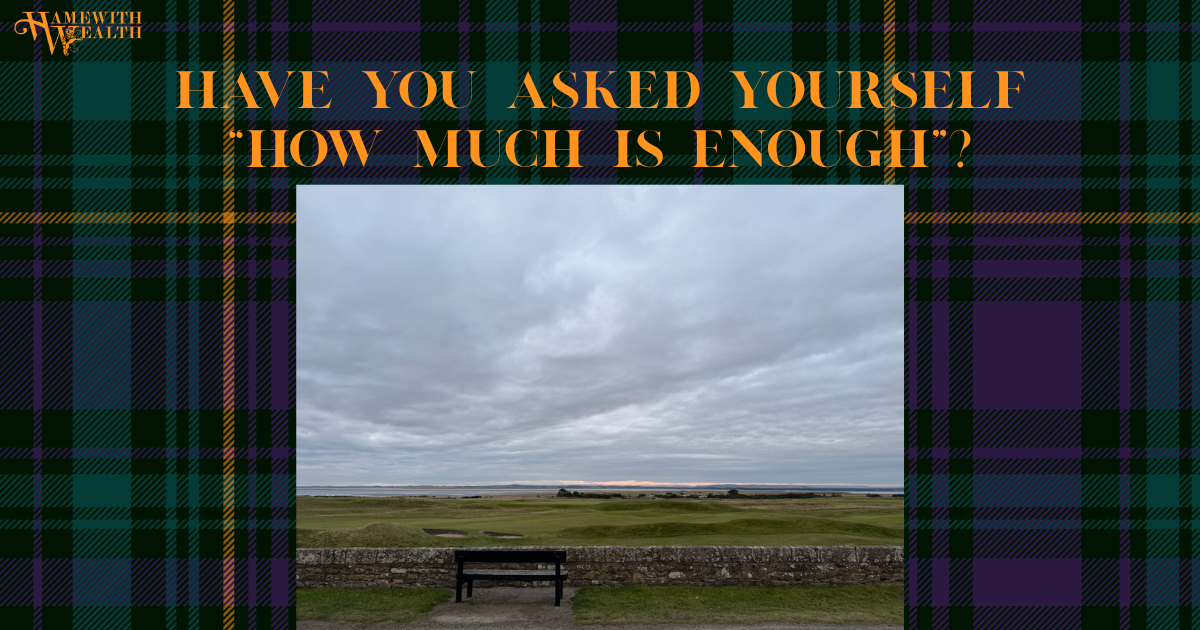
In all of my years of doing financial planning work, I’m not sure that I’ve ever financially planned myself (yeah, I think that’s how you’d say that). Oh sure, I’ve invested for myself, done my own tax planning, and talked with my wife about our spending and what we want retirement to look like.
But I had never just pressed pause on my life and asked myself the simple question:
“How much is enough.”
Let me pepper you with some relevant backstory. I came out of undergrad with a degree in international studies and philosophy, which qualified me for exactly one thing: any job that offered a regular paycheck instead of another shift in a mall store’s inventory room. My income expectations started low and my starting income was commensurately low, but for the first ten years of my career I was focused on increasing my income. And that pursuit persisted because I never bothered to define what the finish line looked like.
As the years went on and I participated in and led more financial planning meetings, I started to understand that there wasn’t exactly a correlation between how much money someone made and how happy they were. Did I internalize that? Not even a little. I kept chasing more anyway, because hey, this is CAPITALISM. How else are you supposed to win at capitalism except by making more money?
The harsh reality that young people rarely hear as they set their sights on growing their career is that you can trade away the only life you get for more money, and not notice you did it until you’re looking all the way back wondering how you got where you are.
I finally stopped. It took just enough sand in my gears for my quiet moments to get uncomfortable and for me to ask myself what my next ten years might look like. And the sketch was fine. Good job, good pay, clients I actually liked. I could see myself sitting in that same chair for a long time, more or less content.
And who among us doesn’t set out to be “more or less content” with their work, right?

But looking out that far caused something to shift in me. It’s like I had performed inception on myself—a seed of an idea had been planted in my head that I couldn’t stop feeding. So I started talking to friends, family, and really anyone else that I could about this piece of sand in my skull that my brain was turning into a pearl. One of those friends is another advisor who’s spent years in lock-step with me that emotional wellbeing belongs in financial planning whether we like it or not. He offered to take me through a life planning session and guided me along some exercises where one of the questions ended up being, in essence, how much is enough?
I had asked that question of probably a hundred clients by that point, but I had never once asked it of myself. Over a decade into a career built on helping other people answer it, and I’d skipped my own homework.
I’ve got a long list of excuses for that, most of them embarrassing, none of them worth repeating. The short version is that I’d spent my whole career chasing arbitrary numbers because chasing them and achieving them felt like progress. When I finally sat still long enough to actually take stock, I realized I already had most of what I wanted by accident and not through intention. That maybe I could ease up on the gas a little bit and start getting to doing what I would regret never having done if I knew I had a week left to live.
That’s the trap, I think. A friend of mine once said to me, “The days are long, but the years are short.” In our lives, each day can feel like a battle and we move through our lives one battle at a time. We might not have the emotional capacity to consider what we want our lives to look like or how to get there, so we end up with the lives that we’ve chosen haphazardly instead of what we would have chosen if we could have done so with intention.
So I did the work for myself that I’ve helped my clients do so many times. I dreamed and came up with what my life would look like in its most ideal form. It turned out that opening my own firm was incredibly important to me. Then I ran my own numbers the way I’d run a client’s: honestly and without the flinching I’d normally do around my own finances. It turned out the numbers were much less scary than I had assumed.
Isn’t it funny how when we remove the uncertainty and understand our situation, fear can turn into hope?

So I took the biggest leap of my life and launched Hamewith Wealth. And the peace that showed up afterward genuinely surprised me. I’ve been a little obsessed ever since with helping other people get to that same moment, minus the many-year delay.
So, I’ll ask you what my friend asked me. How much is enough for you?
I’m not necessarily asking you to understand the numbers of how much is enough for an emergency fund, for a kid’s tuition, or enough to retire without checking your phone every time the market has a bad week. That part of the process is my job and sort of the less interesting side of that question.
The much more interesting side of the question is less clear. It shows up if you’ve ever picked an extra hour of work over an hour with your family and told yourself you’d make it up later. Or traded your time for money in a way that you missed out on something you would have loved not to. Our economy runs on trading time for money, and the more ambitious you are, the easier it is to keep making that trade long after you’ve already won.
The real question inside of “how much is enough” is “why”. Past covering the basics, most of us are working for what the money is supposed to buy: time, freedom, a life that feels like something instead of a waiting room. So what does that actually look like for you? More importantly, what does it feel like? Most financial plans never get around to asking, which means most financial plans are optimizing for nothing in particular. Just like my undergraduate degree.
A means to an end can’t sustain happiness on its own. For us, money is exactly that: a means to an end. At Hamewith, we treat it like a tool for buying a life you actually want, not a scoreboard, because a life spent purely accumulating capital tends to feel pretty hollow no matter how big the number gets.
We focus on wealth well spent.
So, seriously, how much is enough for you? How much travel, how much stuff, how much giving? And how much of your own time are you willing to actually keep, instead of selling it off a little at a time because that’s just what ambitious people do?
If you want a planner who’ll ask you these questions and then build your financial life around the answers instead of around some arbitrary bigger number, that’s exactly what Hamewith Wealth was built for. Let’s talk about that.



Leave A Comment